
TRT & Hair Loss
Separating Truth from Myth
Does TRT cause baldness? We break down the role of DHT, genetic risk factors, and effective strategies to prevent hair loss while on TRT.
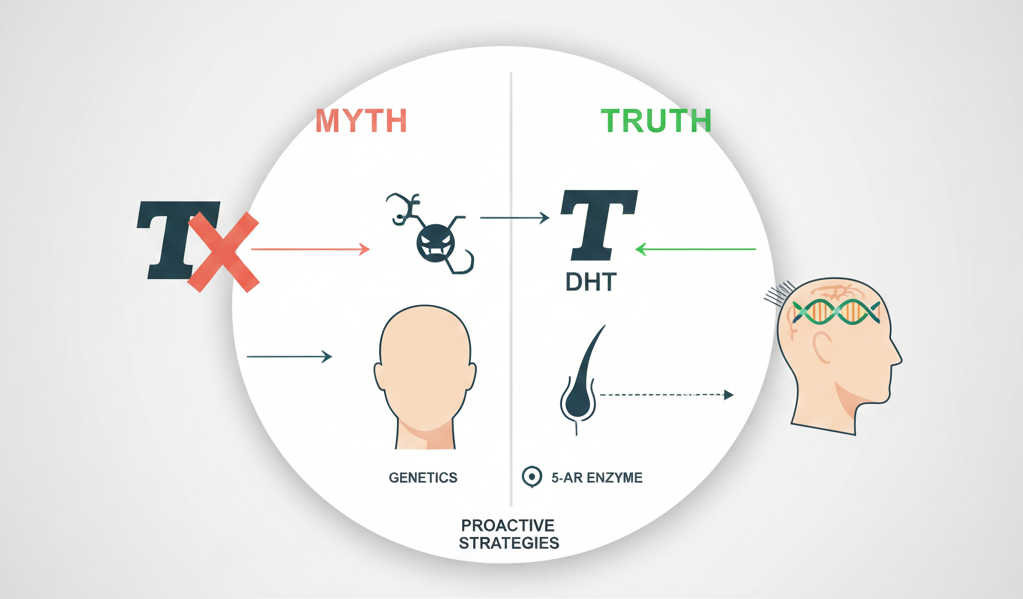
TRT does not cause hair loss — it accelerates genetic hair loss in men already predisposed to androgenetic alopecia (male pattern baldness). The mechanism: TRT increases circulating testosterone, a portion of which is converted by the 5-alpha reductase (5-AR) enzyme into dihydrotestosterone (DHT) — a hormone 5x more potent than testosterone. In men with genetically DHT-sensitive hair follicles (androgen receptor density in the scalp), DHT triggers follicle miniaturization: progressively shorter growth cycles until follicles produce only fine hairs or go dormant. Men without genetic predisposition are highly unlikely to experience hair loss from TRT. Key risk factors: family history of baldness (maternal or paternal), pre-existing hair thinning, delivery method (transdermal gels/creams increase local DHT conversion more than injections), and supraphysiologic dosing. Prevention strategies: (1) 5-alpha reductase inhibitors — finasteride (blocks type II 5-AR, reduces DHT ~70%) or dutasteride (blocks both types, reduces DHT ~90%); both available in topical forms with lower systemic side effects; (2) Minoxidil — vasodilator that extends the follicle growth phase without affecting DHT; (3) PRP therapy and low-level laser light therapy for supportive hair follicle stimulation. You do not have to choose between hormonal health and hair — a proactive monitoring and prevention plan allows both.
The TRT Dilemma: Vitality vs. Hairline
Testosterone Replacement Therapy (TRT) can be life-changing, restoring energy, improving mood, increasing muscle mass, and boosting libido. Yet, for many men considering or starting treatment, one potential side effect looms large: hair loss.
Is TRT a guaranteed ticket to baldness? Must you choose between feeling your best and keeping your hair? The answer is a resounding no. The relationship between TRT and hair loss is far more complex than a simple cause-and-effect, rooted deeply in genetics and hormone metabolism.
The Core Truth
TRT is an Accelerator, Not the Cause
The Myth
Taking external testosterone makes you lose your hair.
The Truth
TRT does not create a new condition of baldness. It only accelerates the process of Androgenetic Alopecia (Male Pattern Baldness) in men who are already genetically predisposed to it.
If you don't carry the genes for pattern baldness, you are highly unlikely to experience significant hair loss from TRT. If your father or grandfathers lost their hair, however, TRT can speed up that process by supplying more raw material for the balding process.
The Science: Why Testosterone isn't the Culprit—It's DHT
To understand the hair loss link, we must look past Testosterone (T) and focus on its potent byproduct: Dihydrotestosterone (DHT).
DHT is an androgen that is several times more potent than testosterone itself. It is responsible for many male characteristics, including body hair and the maturation of the prostate.
The Conversion Pathway:
When you administer testosterone (via injection, gel, or pellet), a portion of that testosterone is metabolized by an enzyme called 5-alpha reductase (5-AR).
This enzyme converts T into DHT.
Because TRT increases the total available T in your system, it often leads to a corresponding increase in DHT.
The Follicle Miniaturization:
In men genetically susceptible to baldness, the hair follicles on the scalp (particularly at the temples and crown) contain an abundance of androgen receptors that are highly sensitive to DHT. When DHT binds to these receptors, it triggers a process called miniaturization. This shrinks the hair follicle, shortening its growth cycle until it eventually produces only fine, thin hairs, or stops producing hair altogether.
Worried About Hair Loss on TRT?
Our medical team can create a personalized plan to protect your hair while optimizing your testosterone.
Book Free ConsultationAre You at Risk? Key Determinants of TRT Hair Loss
Hair loss on TRT is not a universal side effect; it is conditional. Your risk factor is determined by a few key variables:
Genetic Predisposition
The Primary Factor
If male pattern baldness runs in your family (on either side), you have a high density of DHT-sensitive receptors in your scalp, making you the most likely candidate for accelerated hair loss on TRT.
Dose and Administration Route
How You Take TRT Matters
The way you take TRT can influence DHT spikes. Transdermal gels/creams may have higher local conversion to DHT, while injections often yield a lower ratio of DHT relative to T.
Age and Baseline Status
Progressive Condition
Hair loss is often a progressive condition. If you already have mild thinning before starting TRT, the hormonal increase may simply speed up a process that was already in motion.
Dose and Administration Route Details:
| Method | Effect on DHT |
|---|---|
| Transdermal Gels/Creams | May have higher local conversion rate to DHT because the skin is rich in the 5-alpha reductase enzyme. Can lead to higher serum DHT levels. |
| Injections | Generally result in higher total testosterone levels but often yield a lower ratio of DHT relative to T compared to transdermal methods. |
| Supraphysiologic Dosing | Using doses that elevate your total testosterone well above the normal range can significantly increase the amount of T available for conversion to DHT, dramatically increasing risk. |
Proactive Strategies to Save Your Hair on TRT
The good news is that you don't have to choose between hormonal health and hair health. You can enjoy the benefits of TRT while proactively managing hair loss risk.
1Hormonal Adjustments and Monitoring
Optimize Dosing
Ensure your TRT dose is just enough to bring your testosterone into the healthy, physiologic range without excessive peaks that accelerate DHT conversion.
Monitor Levels
Regularly test your Total Testosterone, Free Testosterone, and, if possible, DHT levels to ensure they are within a manageable range for your personal risk tolerance.
2Medical Prevention (5-Alpha Reductase Inhibitors)
Finasteride (Propecia)
Blocks Type II 5-AR, reducing serum DHT by about 70%.
Dutasteride (Avodart)
Blocks both Type I and Type II 5-AR, reducing serum DHT by up to 90%.
Crucial Note: These medications can, in some cases, cause side effects like decreased libido or erectile dysfunction, though often they are well-tolerated when combined with TRT. They should only be used under medical supervision.
3Topical and Supportive Treatments
Topical Finasteride/Dutasteride
Applied directly to the scalp, these can reduce local scalp DHT without significantly affecting systemic DHT levels, minimizing the risk of sexual side effects.
Minoxidil (Rogaine)
This topical solution is a vasodilator that helps improve blood flow to the scalp and extends the hair follicle's growth phase. It does not affect DHT levels but supports the follicles against the effects of DHT.
PRP (Platelet-Rich Plasma) Therapy
Involves drawing the patient's blood, concentrating the platelets, and injecting them into the scalp to stimulate growth factors and prolong the hair cycle.
Low-Level Laser Light Therapy (LLLT)
Non-invasive devices (combs, caps) that stimulate cellular activity in hair follicles.
Ready to Start TRT Safely?
Our comprehensive TRT packages include monitoring and guidance to protect your hair.
Conclusion: Balancing Health and Aesthetics
The truth is that TRT does not make you bald; your genetics do.
If you are genetically predisposed to male pattern baldness, TRT will likely speed up the timeline. However, being informed is your best defense. By partnering with a knowledgeable physician, monitoring your hormone levels, and utilizing modern, targeted treatments like 5-AR inhibitors or topical solutions, you can successfully optimize your testosterone levels and maintain a healthy head of hair.
Don't let a manageable risk stop you from achieving optimal health.
Book Your Free Consultation