
TRT Injections vs Creams vs Troches
Compare TRT delivery methods based on hormone stability, cost, and convenience. Find the best option for your lifestyle.
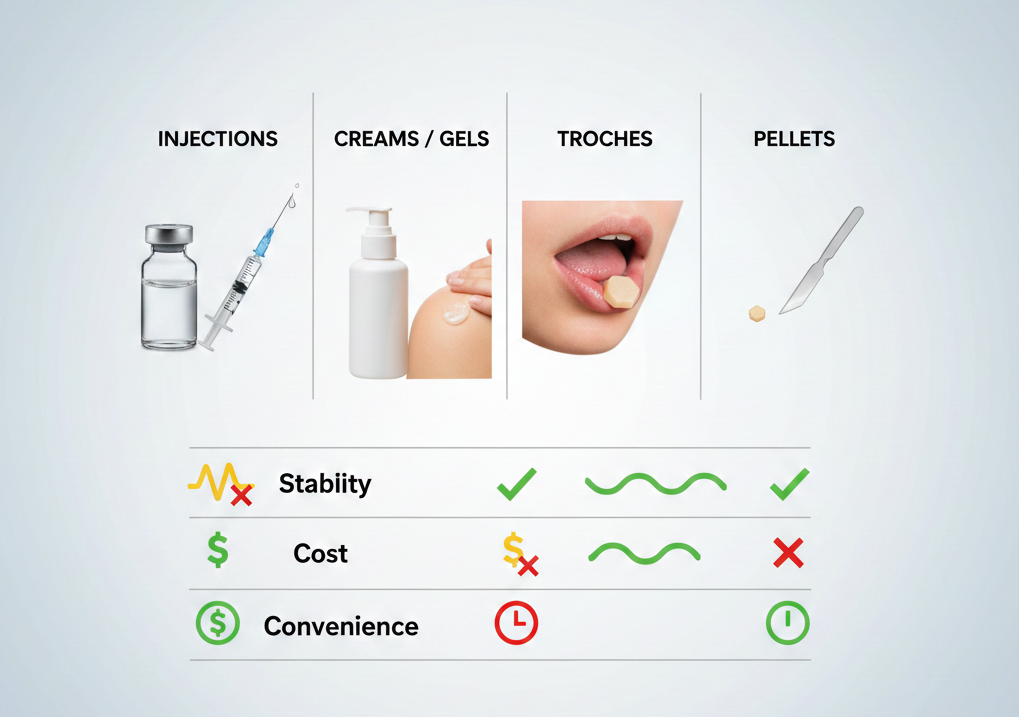
TRT delivery method is one of the most clinically significant decisions in hormone therapy, as it determines hormone stability, DHT conversion rate, cost, transference risk, and ultimately long-term compliance. Injections (Testosterone Cypionate/Enanthate): most cost-effective (often insurance-covered), reliable absorption, but cause peaks and troughs (supraphysiologic spike then crash), requiring weekly or biweekly self-injection. Topical creams/gels: provide the most physiologically stable levels mimicking the body's natural daily rhythm — best for hormone consistency — but require strict daily application and carry HIGH transference risk to partners and children via skin contact. Troches/sublingual tablets: needle-free, bypass liver metabolism, but require 1–2 daily dissolutions (10–15 minutes each), cause moderate hormone spikes, and often have a bitter taste. Pellets: maximum convenience (dosing every 3–6 months via minor in-office procedure), very stable delivery, but most expensive, cannot adjust dose mid-cycle, and some men experience an end-of-cycle dip. Key decision factors: hormone stability needs, needle tolerance, transference risk (presence of children/partners), budget, and lifestyle compliance. The best method is the one you'll adhere to consistently — compliance drives outcomes more than pharmacokinetics.
Introduction & Foundation
Why the Delivery Method is Key to Symptom Relief
Testosterone Replacement Therapy (TRT) is highly effective at reversing the symptoms of male hypogonadism. However, a successful treatment plan hinges on more than just the dosage; it relies fundamentally on the delivery method.
Each method—from injections that spike T levels to creams that offer a daily steady release—has a unique pharmacokinetic profile (how the drug moves through the body).
Hormone Stability
The consistency of your T levels between doses, which affects mood, energy, and sexual function.
Compliance
How easily the treatment fits into your daily life, which is the ultimate predictor of long-term success.
The decision is deeply personal and must balance clinical efficacy with lifestyle preferences, budget, and tolerance for administration.
Core Comparison: The Top 4 Methods
Detailed breakdown of each TRT delivery method
Testosterone Injections
(Cypionate/Enanthate)
Injections are the most widely prescribed and cost-effective method of TRT. They involve injecting testosterone into a muscle (intramuscular, IM) or under the skin (subcutaneous, SubQ), typically on a weekly or bi-weekly schedule.
Pros
Cost-Effective
Often the most affordable option, generally covered by insurance.
Reliable Absorption
Direct delivery into the bloodstream ensures high, consistent absorption.
Less Frequent Dosing
Typically administered every 7–14 days.
Cons
Hormonal Peaks and Troughs
Levels spike immediately after injection and decline sharply before the next dose, potentially causing mood swings, irritability, or fatigue mid-cycle.
Invasive
Requires comfort with needles and self-injection, or regular clinic visits.
Injection Site Reactions
Possible pain, swelling, or scarring at the injection site.
Topical Creams and Gels
(Transdermal)
Transdermal methods deliver testosterone through the skin, mimicking the body's natural daily production rhythm. They are typically applied once daily to areas like the shoulders, upper arms, or scrotum.
Pros
Physiological Stability
Provides a gradual, continuous release of T, avoiding the sharp peaks and troughs of injections.
Non-Invasive
Ideal for those with needle aversion.
Easy Dosage Adjustment
Dose can be fine-tuned daily by changing the amount applied.
Cons
Risk of Transference
Requires extreme care to avoid transferring the hormone to children, partners, or pets via skin-to-skin contact or unwashed clothing.
Inconsistent Absorption
Absorption can vary based on skin type, application site, and hydration.
Daily Commitment
Requires meticulous daily application at the same time.
Buccal/Sublingual Troches
(Oral Mucosa)
Troches (or lozenges) are small tablets designed to dissolve slowly between the cheek and gum (buccal) or under the tongue (sublingual). This delivery bypasses the digestive system and liver.
Pros
Avoids Liver
Absorption through the oral mucosa prevents the 'first-pass' effect on the liver, unlike traditional oral pills.
Mimics Rhythm
Can provide a quick spike in T, similar to the natural morning peak.
Non-Invasive
Needle-free and no risk of transference once dissolved.
Cons
Compliance & Inconvenience
Requires 10–15 minutes to fully dissolve, during which talking, eating, or drinking is restricted. Often dosed twice daily.
Taste and Irritation
Patients often report a bitter taste and potential gum/mouth irritation that requires rotating the placement site.
Not FDA-Approved
Many troche formulations are compounded and not reviewed by the FDA, though the compounds themselves are often FDA-approved.
Implantable Pellets
(Subdermal)
Testosterone pellets are small implants (the size of a grain of rice) inserted under the skin of the hip or buttocks during a minor in-office procedure.
Pros
Maximum Convenience
Requires dosing only every 3–6 months.
Highest Compliance
Eliminates the daily/weekly routine, making it ideal for frequent travelers or those who forget doses.
Consistent Delivery
Provides a very steady, reliable release of T over the long term.
Cons
Invasive Procedure
Requires a minor surgical incision and local anesthesia, carrying risks of infection, bleeding, or pellet extrusion.
Difficult to Adjust
Once implanted, the dosage cannot be changed until the pellets wear off, which can take months.
End-of-Cycle Dip
Some men experience a sharp drop in T levels and returning symptoms just before the next insertion is due.
Not Sure Which Method is Right for You?
Our medical team will help you choose the best TRT delivery method for your lifestyle.
Book Free ConsultationDirect Comparison Metrics
Stability, Risk, and Cost: A Comparative Chart
| Factor | Injections | Creams/Gels | Troches | Pellets |
|---|---|---|---|---|
| Hormone Stability | Low (High Peaks/Troughs) | High (Steady, Physiological) | Moderate (Spikes, then Drops) | High (Very Steady, Long-Term) |
| Cost | Lowest (Often Covered by Insurance) | Moderate to High (Often Compounded) | Moderate | High (Procedure Fee + Drug Cost) |
| Administration | Every 1–2 Weeks | Daily | 1–2 Times Daily | Every 3–6 Months |
| Invasiveness | Requires Needle/Injection | Non-Invasive (Topical) | Non-Invasive (Oral) | Minor Surgical Procedure |
| Transference Risk | Virtually Zero | High Risk (Requires Washing/Covering) | Zero | Zero |
Hormone Stability: Peaks vs. Physiological Rhythm
Injections and Troches are characterized by a supraphysiological peak followed by a sub-therapeutic trough. This fluctuation can cause the "roller coaster effect" of mood swings, irritability, and fluctuating libido.
Creams/Gels and Pellets prioritize stability, delivering a consistent concentration of testosterone to avoid these mood and energy dips.
Risk of Transference and Needle Aversion
For men with partners or young children, Transdermal Creams pose a significant risk, necessitating strict hygiene protocols.
For those with needle aversion, injections are immediately ruled out, making creams/gels, troches, or pellets the only viable alternatives.
Making Your Personalized Choice
Choosing Your TRT: Matching the Method to Your Lifestyle
The "best" delivery method is the one that you can adhere to consistently, achieving stable therapeutic levels with minimal disruption to your life.
Choose Injections if:
Cost and reliable absorption are your top priorities, and you are comfortable with needles and managing hormone fluctuations.
Choose Creams/Gels if:
You prioritize hormone stability and a non-invasive, daily routine, and you can strictly adhere to transference prevention protocols.
Choose Troches if:
You need a needle-free option that bypasses the liver, but you are willing to manage the inconvenience of twice-daily oral dosing.
Choose Pellets if:
You prioritize maximum convenience and stability, and you are willing to accept the higher upfront cost and the inability to quickly adjust the dosage.
Ready to Start TRT?
Explore our comprehensive TRT packages with expert medical guidance.
Customizing Your Longevity with Live Forever Health
Deciding on the right TRT delivery method is a crucial step in your health journey—one that dictates not only your hormone levels but your daily quality of life. Whether you seek the stability of a daily cream or the low-frequency convenience of an injection, the most effective therapy is ultimately the one you commit to consistently.
At Live Forever Health, we understand that longevity is personalized medicine. We empower you to work with your provider to choose a method that aligns with your biology, your budget, and your definition of optimal living.
Don't let a treatment routine dictate your life. Choose the TRT delivery method that makes consistency easy.
Book Your Free Consultation