
How Technology Is Revolutionizing Personalized Health Optimization
The New Era of Health Is Personal and Predictive
What if your smartwatch could predict burnout, detect nutrient deficiencies, and optimize your sleep—all before symptoms appear? That's not science fiction—it's the promise of personalized health technology.
By integrating AI, digital data analytics, and biofeedback, today's health tools can tailor wellness strategies to each individual's biology. Gone are the days of one-size-fits-all prescriptions; the shift is from reactive treatment to proactive optimization.
Personalized health optimization is reshaping how we prevent disease, enhance longevity, and design daily wellness routines, making it possible to intervene before illness occurs and optimize every aspect of our biological and cognitive performance.
The Shift from General Healthcare to Personalized Health Optimization
Why the One-Size-Fits-All Model Is Broken
Traditional healthcare often waits until illness appears. Modern consumers demand prevention over prescription. Studies from JMIR confirm that personalized approaches improve outcomes, adherence, and patient engagement.
Data as the New Doctor
Digital biomarkers—like heart rate variability (HRV), sleep patterns, and glucose trends—create a constant feedback loop that reveals early health risks. Tiga Health emphasizes this era as one of predictive personalization, where continuous data drives timely, individualized interventions.
Core Technologies Powering Personalized Health Optimization
1. Artificial Intelligence and Predictive Analytics
AI systems analyze health data to forecast risks and suggest interventions. Wavetec reports that AI can predict chronic disease patterns based on lifestyle trends. Apps like InsideTracker, WHOOP, and Garmin now offer real-time health guidance.
2. Wearable Health Devices
Smartwatches, glucose monitors, and Oura Rings track continuous physiology, providing actionable insights beyond traditional checkups. FDA-approved devices now enable precision health feedback, empowering users to optimize recovery, stress management, and performance.
3. Genomic and Epigenetic Profiling
Genetic testing identifies predispositions; epigenetic data shows how lifestyle influences gene expression. Personalized DNA-informed plans can optimize nutrition, sleep, and activity to reduce risk and enhance longevity.
4. Personalized Apps and Virtual Health Coaches
Behavioral data + AI deliver adaptive wellness recommendations. LFH-style dashboards integrate data streams into actionable guidance, combining automation with human coaching for habit formation.
The Real-Time Feedback Loop: From Data to Daily Action
How Data Becomes Actionable Insights
Example: A continuous glucose monitor detects sugar spikes, prompting an app to recommend walking or hydration. Tiga Health calls this "insight to intervention." AI personalizes recommendations dynamically, improving adherence and long-term results.
Integrating Wellness Optimization at Home
Smart sleep devices (Oura, Eight Sleep), nutrition tracking apps (Cronometer, MyFitnessPal), and recovery monitors (WHOOP, Fitbit) bring precision health into daily routines.
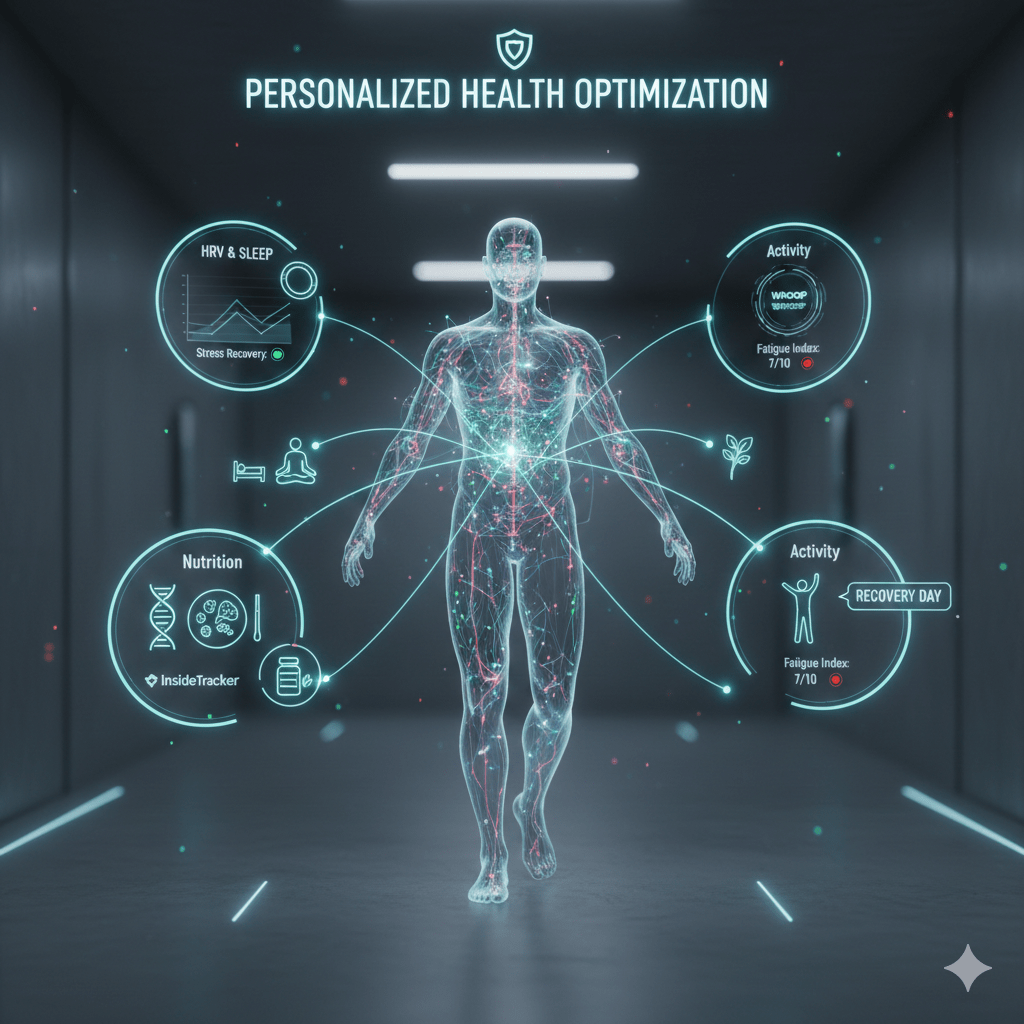
Daily Health Optimization Stack:
1. HRV & Sleep Monitoring
- Tool/Source: Data for Heart Rate Variability (HRV) and Sleep quality is captured using the Oura Ring.
- Output/Metric: The primary metric tracked is Stress recovery.
- Personalized Adjustment: If stress recovery scores are low, the resulting action is a proactive recovery effort, such as prioritizing Meditation or ensuring an early bedtime.
2. Nutritional Analysis
- Tool/Source: Nutrition insights are derived from bloodwork analysis using InsideTracker.
- Output/Metric: This identifies specific biomarkers, primarily highlighting any Vitamin deficiencies.
- Personalized Adjustment: Based on the identified deficiencies, the action item is implementing specific Diet recommendations to correct the imbalance.
3. Activity and Strain Tracking
- Tool/Source: Daily Activity levels and physiological strain are monitored by the WHOOP strap.
- Output/Metric: The key metric provided is the Fatigue index, which gauges the body's readiness for strain.
- Personalized Adjustment: A high fatigue index triggers a formal Recovery protocol, which may involve lighter training or active rest.
How AI Is Transforming the Doctor-Patient Relationship
AI shifts healthcare from diagnosis alone to collaboration. Algorithms interpret data; clinicians provide context. Wavetec highlights AI-powered dashboards as enhancing communication, while JMIR emphasizes digital tools improve self-management for chronic conditions.
LFH insight: technology empowers patients to become co-creators of their wellness journey.
Privacy, Ethics, and the Future of Data Ownership
Balancing innovation with data protection is critical. HIPAA, GDPR, and patient-controlled models define current compliance standards. Emerging solutions, such as blockchain, may securely exchange personal health data, empowering patients to own—not just share—their wellness information.
LFH approach: "Empower users to own their wellness data."
The Future Landscape of Personalized Health Technology
Integrating AI + Human Coaching for Longevity
Hybrid systems combine algorithmic insight with human empathy, allowing AI to detect trends and coaches to guide behavioral change.
Beyond Wearables — Invisible Health Tech
Smart textiles, implantable sensors, and ambient monitoring will predict and optimize recovery, stress, and nutrition in real-time.
From Data to Longevity Optimization
Integration of AI, genomics, and lifestyle data creates personalized longevity maps, shifting wellness from treatment to continuous optimization.
How Live Forever Health Aligns with the Health-Tech Revolution
LFH integrates personalized wellness plans powered by AI and human expertise, bridging biological individuality with daily optimization habits.
Conclusion — The Future of Health Is Personal, Predictive, and Proactive
Technology isn't replacing doctors—it's upgrading how we live, prevent disease, and thrive.
By leveraging AI, wearables, and genomics, personalized health optimization puts data-driven wellness at the heart of longevity.