
How to Read Your Testosterone Labs
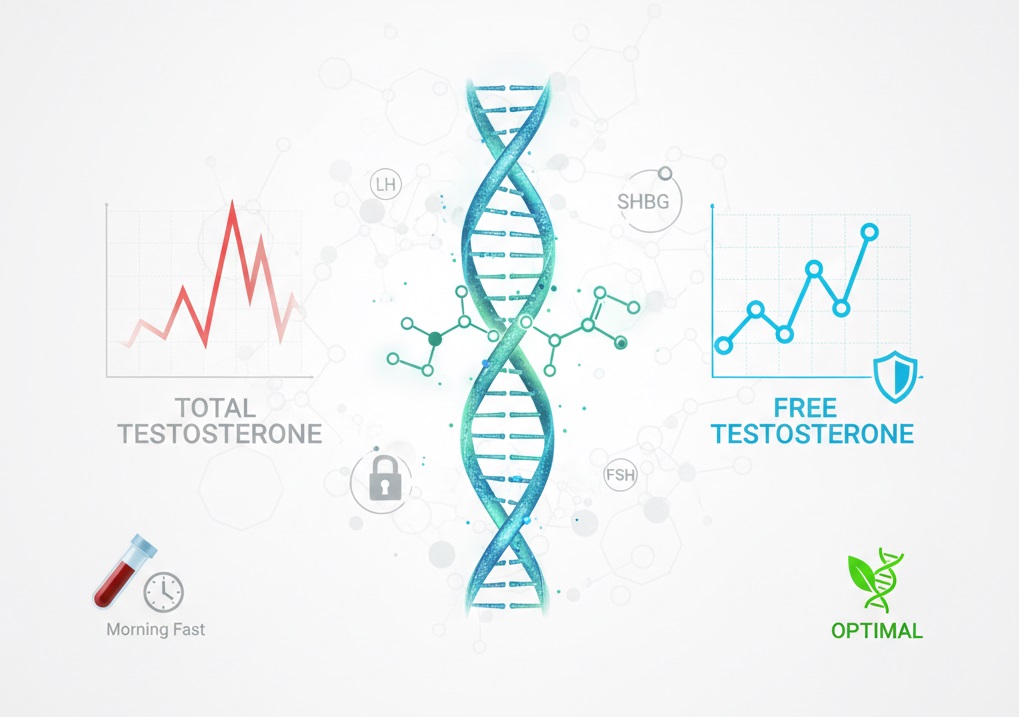
Understanding the difference between Total and Free Testosterone, why SHBG matters, and how to properly prepare for accurate testing.
Total Testosterone alone is misleading—up to 65% is bound to SHBG (unusable). What matters is Free Testosterone (1–3%, the active hormone) and Bioavailable T (Free T + albumin-bound). SHBG is the key variable: high SHBG (from aging or over-training) traps testosterone; low SHBG (from insulin resistance) causes rapid clearance. Always check LH/FSH to identify root cause: high LH + low T = testicular failure (primary); low LH + low T = brain signaling failure (secondary). Test in the morning (7–10 AM), fasted, after 7–8 hours sleep. Optimal (not just 'normal') targets: Total T 700–900 ng/dL, Free T 15–25 pg/mL, Estradiol 20–30 pg/mL.
Table of Content
The Hierarchy of Measurement: Total vs. Free vs. Bioavailable
The most common mistake patients (and some practitioners) make is looking exclusively at Total Testosterone. This is equivalent to checking the total amount of money in your bank account without knowing how much is frozen in a long-term trust fund.
At Live Forever Health, we take a comprehensive approach to understanding your hormonal landscape.
Understanding Testosterone Distribution
| Type | Percentage | Status |
|---|---|---|
| SHBG-Bound | 45-65% | Tightly bound; essentially 'locked' and unusable |
| Albumin-Bound | 35-50% | Weakly bound; 'bioavailable' |
| Free T | 1-3% | Completely unbound; 'active' |
1. Total Testosterone (TT)
This is the sum of all testosterone in your bloodstream. It includes testosterone bound to proteins and the small amount that is unattached.
- The "Normal" Range: While many labs cite 300 to 1,000 ng/dL, medical consensus—including the American Urological Association (AUA)—defines "low" as below 300 ng/dL.
- The Limitation: Total Testosterone can be deceptive. A man can have a "high-normal" Total T of 700 ng/dL but still feel the symptoms of low energy and brain fog if his Free Testosterone is suppressed by high binding proteins.
2. Free Testosterone (fT)
This is the "active" hormone. Only about 2% to 3% of your testosterone is truly "free"—unattached to any proteins and able to enter your cells to bind with androgen receptors.
- The Clinical Gold Standard: Free Testosterone is often a more accurate predictor of symptoms like low libido, muscle loss, and depression than Total T.
- Range: Typically measured in pg/mL (picograms per milliliter) or ng/dL. For men, a healthy optimal range is often considered 15 to 25 pg/mL, though "lab normal" starts as low as 5 pg/mL.
3. Bioavailable Testosterone
This represents the "usable" pool. It is the sum of your Free Testosterone plus the testosterone loosely bound to Albumin. Because the albumin bond is weak, your body can easily detach this testosterone when it needs it.
Need Help Understanding Your Labs?
Our medical team specializes in comprehensive hormone analysis and personalized optimization protocols.
The Gatekeeper: Understanding SHBG
Sex Hormone-Binding Globulin (SHBG) is a protein produced by the liver that acts as a "carrier" for sex hormones. It is the single most important variable in determining how much of your Total T is actually reaching your tissues.
High SHBG
Often caused by aging, over-training, or hyperthyroidism. High SHBG "soaks up" your testosterone, leaving you with low Free T despite a high Total T.
Low SHBG
Often a marker of Insulin Resistance, obesity, or metabolic syndrome. While low SHBG increases Free T, it causes your body to clear testosterone rapidly, leading to unstable hormonal "peaks and valleys."
The Signaling Chain: Pituitary vs. Testicular Failure
When a lab result shows low testosterone, the next clinical question is: Why? To answer this, we look at the communication between the brain and the body. This is known as the Hypothalamic-Pituitary-Gonadal (HPG) Axis. We measure this using two primary signaling hormones: Luteinizing Hormone (LH) and Follicle-Stimulating Hormone (FSH).
1. Primary Hypogonadism (The "Factory" Problem)
In this scenario, your brain is screaming for more testosterone, but your testes are unable to produce it.
The Lab Pattern: Low Testosterone + High LH / High FSH
The Interpretation: Your pituitary gland is functioning perfectly; it is sending massive amounts of LH (the signal to produce T) and FSH (the signal to produce sperm), but the testes are unresponsive. This can be caused by physical injury, aging (Leydig cell depletion), or certain genetic conditions.
2. Secondary Hypogonadism (The "Control Center" Problem)
Here, the testes are capable of producing testosterone, but they aren't receiving the signal from the brain to do so.
The Lab Pattern: Low Testosterone + Low or "Normal" LH / FSH
The Interpretation: If testosterone is low, LH should be high. If LH is "normal" or low in the presence of low T, the signaling pathway is broken. This is often caused by high stress (cortisol), poor sleep, obesity, or the use of medications/opioids that suppress the pituitary gland.
The Secondary Markers: Prolactin and Estradiol
A comprehensive testosterone panel is incomplete without looking at the "counter-hormones" that can suppress your levels or mimic the symptoms of deficiency.
1. Estradiol (E2)
Estradiol is the primary form of estrogen. In men, it is created when testosterone is converted by the enzyme aromatase.
- The Balance: You need estrogen for bone health and libido, but if it is too high relative to testosterone, it can cause weight gain and mood swings.
- The Feedback Loop: High Estradiol tells the brain you have "plenty of hormones," which causes the pituitary to shut down LH production, further lowering your testosterone.
2. Prolactin
Prolactin is typically associated with lactation, but it exists in men as well.
The Red Flag: If Prolactin is significantly elevated (Hyperprolactinemia), it acts as a direct "off switch" for the HPG axis. High Prolactin can be caused by extreme stress, certain medications, or, in rare cases, a benign pituitary growth (prolactinoma).
"Normal" vs. "Optimal": The Live Forever Standard
Standard lab reference ranges are based on a bell curve of the general population—a population that is increasingly sedentary and metabolically unhealthy. At Live Forever Health, we do not aim for "average"; we aim for Optimization.
| Marker | Conventional "Normal" | Live Forever "Optimal" |
|---|---|---|
| Total Testosterone | 300 – 1,000 ng/dL | 700 – 900 ng/dL |
| Free Testosterone | 5 – 21 pg/mL | 15 – 25 pg/mL |
| SHBG | 16 – 55 nmol/L | 25 – 40 nmol/L |
| Estradiol (E2) | 10 – 40 pg/mL | 20 – 30 pg/mL |
The Symptom Check
A lab result is only half the story. If your Total T is 450 ng/dL (technically "normal") but you have zero libido and chronic fatigue, you are functionally deficient. We treat the patient, not just the paper.
Get Personalized Hormone Optimization
Our comprehensive programs combine precision testing, bioidentical hormones, and ongoing monitoring to help you achieve optimal levels.
Explore Hormone TherapyCritical Pre-Lab Requirements: Don't Waste Your Draw
A blood test is only as accurate as the environment in which it was taken. Because testosterone is highly sensitive to external variables, failing to follow strict pre-lab protocols can lead to "false lows" that result in unnecessary treatment, or "false normals" that mask a real issue.
At Live Forever Health, we require all patients to adhere to the following four pillars of lab preparation:
The Morning Window
Blood draw between 7:00 AM - 10:00 AM
Why: Testosterone peaks in early morning; afternoon levels can be 25-30% lower
The Fasting State
10-12 hour fast (water only)
Why: Meals can temporarily suppress testosterone by up to 20%
Sleep & Stress Recovery
Minimum 7-8 hours sleep night before
Why: Poor sleep can drop testosterone to levels 10-15 years older
Medication Awareness
Stop Biotin 72 hours before; disclose all prescriptions
Why: Biotin interferes with lab technology; opioids/steroids suppress testosterone
The Workout Rule
Avoid strenuous, heavy weightlifting or endurance training for 24–48 hours before your test. Intense exercise causes acute inflammation and spikes cortisol and Creatine Kinase (CK), which can temporarily skew your hormonal markers and liver enzymes.
Conclusion: Data-Driven Optimization
Reading your testosterone labs is about more than just finding a number; it's about understanding the symphony of signals that dictate your vitality. By looking at the relationship between Total T, Free T, SHBG, and LH, we can move away from guesswork and toward a precise, individualized protocol.
Remember: Reference ranges are not goals. Our goal at Live Forever Health is to move you from "statistically average" to "biologically optimal."
Take Control of Your Hormonal Health
Understanding your labs is the first step toward optimization. With the right knowledge and medical support, you can achieve peak vitality at any age.
Learn more about our precision approach at Live Forever Health.
Frequently Asked Questions
Can I drink black coffee before my test?
It is best to stick to water only. While black coffee doesn't have calories, the caffeine can spike cortisol, which may subtly influence the results.
My doctor said 350 ng/dL is normal. Why do I feel terrible?
350 ng/dL is at the bottom of the 'normal' range. For many men, symptoms of deficiency begin below 450–500 ng/dL. We look at symptoms first, numbers second.
Does a high SHBG mean I have low testosterone?
Not necessarily, but it means you have less usable (Free) testosterone. You could have a Total T of 800, but if your SHBG is 70, your Free T will be low.
What if my LH is high but my Testosterone is low?
This indicates 'Primary Hypogonadism,' meaning the signal from the brain is reaching the testes, but the testes are failing to produce the hormone.
How often should I get my labs done?
If you are on a protocol, every 3 months until stable. For general health monitoring, once or twice a year is sufficient.
Ready to Optimize Your Testosterone?
Get comprehensive lab analysis and personalized treatment from our expert medical team. Start your journey to peak vitality today.
Available in all 50 states • Telemedicine & In-Person Options